 +86 18751738721
 sales@unitatransformer.com
Against the backdrop of rapid growth in utility-scale energy storage infrastructure across Central Asia, project owners are pursuing simplified construction workflows, smaller land occupation and lower overall engineering costs. As a result, traditional discrete layouts with separate PCS rooms, transformer bays and high-voltage distribution buildings gradually expose obvious drawbacks such as large land occupation, complicated wiring and prolonged on-site commissioning. To address these market demands and draw on years of accumulated technical experience, ChinaUnita Electric has launched the Centralized Energy Storage PCS & Step-Up Integrated Unit, a highly integrated packaged solution for large battery energy storage stations.
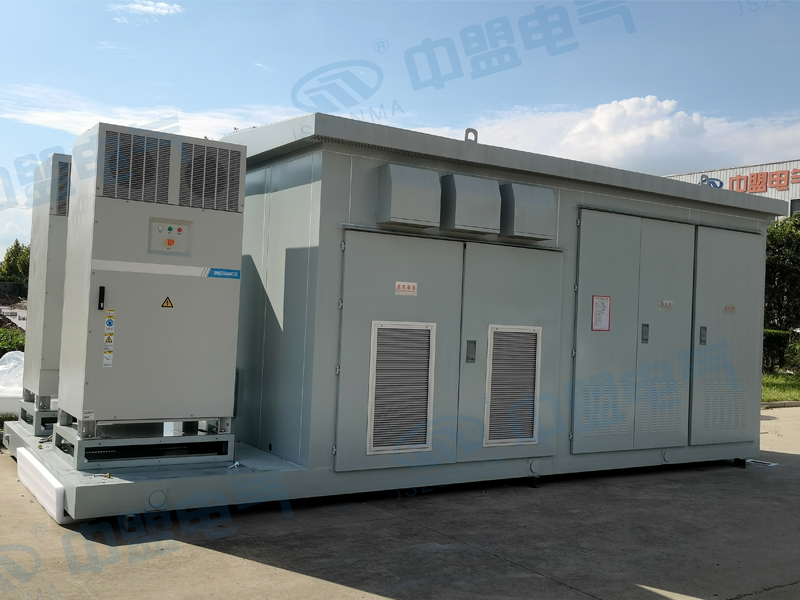
This equipment integrates PCS, step-up transformer, high-voltage power cabinet, fire suppression system, environmental monitoring and other subsystems. Meanwhile, a local controller is deployed to realize comprehensive management of all equipment layers with unified communication interfaces and protocols. In addition, the unit supports grid connection at AC voltage levels ranging from 6kV to 35kV. Moreover, the whole series adopts standardized skid-mounted prefabricated cabin architecture; thanks to high-level integration, transportation, on-site installation and commissioning can be completed far more efficiently.
Technical Highlights of Centralized Energy Storage PCS & Step-Up Integrated Unit
1. Highly Integrated Architecture Maximizes Space Utilization
To begin with, the modular stacked framework and prefabricated cabin design break the limitations of conventional decentralized installation schemes.
• Space utilization rate rises by 60%: PCS (Power Conversion System), dry-type transformer, BMS and high-voltage switchgear are consolidated inside one single prefabricated cabin. Consequently, the overall floor area accounts for less than one-third of traditional separated layouts.
• In-depth integration of secondary systems: Built-in full power measurement modules, synchronous clock devices and communication management units enable unified collection of telemetry, tele-signaling and remote control signals. In this way, cable laying volume can be reduced by 30%.
• Optimized coordination between AC and DC sides: An innovative back-to-back layout for “PCS + step-up transformer” forms a circular busbar for power loops. As a result, line transmission losses can be lowered by up to 8%.
2. Intelligent IoT Architecture Enables Digital Twin Operation & Maintenance
Furthermore, an edge-computing intelligent control hub forms the core of its digital operation system.
• Plug-and-play communication architecture: Dual-network redundant interfaces complying with IEC 61850-9-2 / GOOSE standards are equipped as standard. Therefore, seamless interconnection with SCADA and EMS platforms can be realized, cutting field commissioning cycles by more than 50%.
• Fiber-optic ring sensing network: Built-in industrial ring network switches support millisecond-level synchronous status monitoring, and fault location accuracy reaches the millisecond scale.
• Digital twin O&M platform: A 3D visual interface dynamically displays temperature field distribution, efficiency curves and equipment health status of each unit. Accordingly, the accuracy of predictive maintenance exceeds 95%.
3. Advanced Power Electronics Delivers Industry-Leading Performance
Apart from digital intelligence, innovative power electronic topology lays a solid foundation for reliable operation.
• Adopting three-level Neutral-Point Clamped (NPC) topology together with Silicon Carbide (SiC) power devices, the switching frequency is lifted to 5kHz, and overall conversion efficiency exceeds 99%.
• Full power range supports continuous 1.2 times overload capacity, which satisfies the response requirements of primary frequency regulation for power grids.
• An innovative hybrid cooling scheme combining liquid cooling and air cooling guarantees full-power operation without derating under ambient temperature up to 45℃.
In terms of voltage adaptability for diverse working conditions:
• The step-up module supports multi-level AC output including 10kV and 35kV, compatible with integrated air-cooled or liquid-cooled transformer schemes.
• The DC side covers a wide voltage range of 600V–1500V, matching multiple battery cluster types such as lithium iron phosphate and lithium titanate.
• Reactive power support capacity reaches ±2MVar, which effectively improves grid voltage stability.
4. Intelligent Strategy Engine Unlocks Multi-Dimensional Application Value
On top of hardware performance, flexible energy management strategies expand its application scenarios significantly.
• Supporting 9 operation modes including PQ control, VF control and droop control, seamless switching can be realized between grid-tied and islanded operation modes.
• Multi-unit parallel connection adopts Virtual Synchronous Generator (VSG) technology, enabling smooth capacity expansion from kilowatt scale up to hundreds of megawatts.
• Intelligent power allocation algorithm precisely controls the charge-discharge balance deviation of multiple battery clusters below 0.5%.
In addition, deep coordination capability with power grids strengthens system practicability:
• It constructs the control layer of Virtual Power Plant (VPP) to realize advanced auxiliary services including primary frequency regulation, secondary frequency regulation and inertia support.
• Automatic parsing of demand response instructions enables peak shaving and valley filling depth up to 35%.
• Functions of energy storage PCS and Static Var Generator (SVG) are deeply integrated; the response time of dynamic reactive power compensation is shorter than 5ms.
Core Application Scenarios
Benefiting from high integration, wide voltage adaptability, intelligent control and strong grid support capability, the Centralized energy storage PCS step-up integrated unit for large-scale utility BESS projects in Central Asia is widely deployed in these projects:
- Large-scale centralized utility battery energy storage power stations
- New energy matching energy storage supporting photovoltaic and wind farms
- Industrial & commercial peak-shaving energy storage systems
- Microgrid and isolated power supply projects for mining zones
- Virtual power plant (VPP) aggregation and grid ancillary service stations
Conclusion
To sum up, traditional separated PCS, transformer and high-voltage cabinet schemes require extensive civil construction, complicated on-site wiring and lengthy commissioning cycles, which cannot meet the fast-track deployment demands of modern large-scale energy storage stations. By contrast, ChinaUnita Electric centralized energy storage PCS & step-up integrated unit integrates power conversion, voltage boosting, power distribution, safety protection and intelligent monitoring within one prefabricated cabin.
It balances compact footprint, high energy conversion efficiency, strong grid auxiliary service capacity and convenient modular expansion. Furthermore, the skid-mounted design shortens site construction periods and effectively controls overall project investment, making it a preferred system solution for utility-scale energy storage projects in Kazakhstan, Uzbekistan and other Central Asian countries.
If you are planning large-scale energy storage bidding projects, please fill in the inquiry form below. Our energy storage system engineers will provide targeted technical configuration schemes and accurate quotation within 24 hours.
Blog – Distribution transformer,Oil immersed transformer,Dry type transformer-Unita Electric