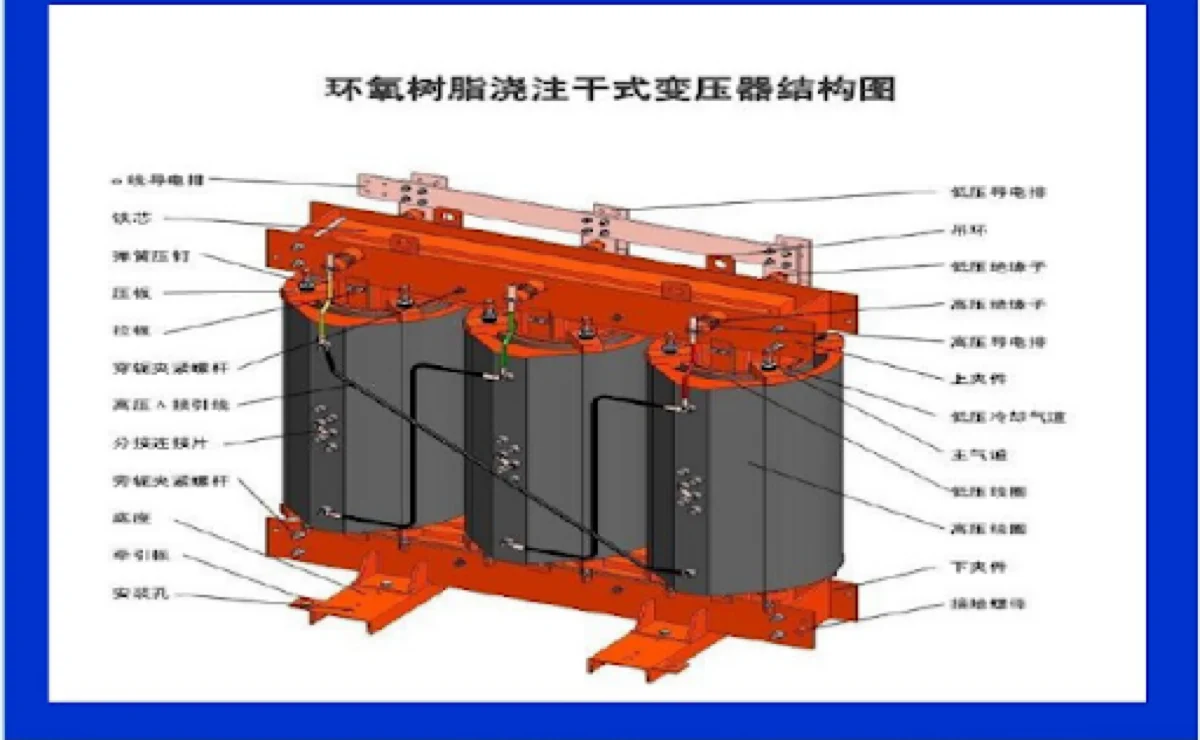
A Dry Type Transformer is an electrical transformer that does not use liquid cooling media, relying instead on air or other gases for heat dissipation. According to the International Electrotechnical Commission (IEC) standard IEC 60076-11 and the Chinese National Standard GB 1094.11-2007, these transformers utilize vacuum pressure impregnation (VPI) or epoxy resin casting for insulation, with an operating voltage range of 1kV to 35kV. Compared to traditional oil-immersed transformers, dry type transformers offer enhanced safety and environmental friendliness, making them widely applicable in commercial buildings, industrial facilities, and renewable energy projects. The global dry type transformer market was valued at USD 6.51 billion in 2024 and is projected to reach USD 10.47 billion by 2032, growing at a CAGR of 6.30%.
Technical Characteristics
The core advantages of dry type transformers lie in their innovative insulation and cooling designs:
Insulation System:
Epoxy resin casting or vacuum pressure impregnation (VPI) processes are used, with windings covered in high-temperature insulation materials (e.g., Nomex paper or fiberglass), providing exceptional dielectric strength.
Insulation classes typically reach Class F (155°C) or Class H (180°C), complying with UL 1561 standards.
Cooling Methods:
Natural Air Cooling (AN): Capable of continuous operation at rated capacity.
Forced Air Cooling (AF): Enhanced heat dissipation via fans, allowing short-term overload capacity to increase by 50%.
Structural Design:
Core made from cold-rolled silicon steel laminations, with magnetic flux density controlled between 1.6-1.7 Tesla, reducing core losses.
Windings use copper foil or aluminum conductors to minimize load losses.
Protection Level:
Enclosure protection up to IP54 (dust and splash proof), suitable for harsh environments.
Global Market Applications
Dry type transformers are widely used due to their safety and environmental adaptability:
Commercial and Industrial Sectors:
Used in hospitals, schools, office buildings, and factories where fire and explosion prevention are critical.
Capacity typically ranges from 50kVA to 1600kVA, with voltage levels below 10kV.
Renewable Energy Integration:
Wind and solar projects require transformers to step up medium voltage to transmission levels, and dry type transformers are preferred for their eco-friendliness.
For example, Hitachi Energy provided dry type transformers for the 4.75 GW renewable energy park in Gujarat, India.
Infrastructure Modernization:
The upgrade of aging power grids globally drives demand for dry type transformers, especially in North America and Europe.
The U.S. plans to invest USD 1.1 trillion in grid modernization, where dry type transformers will play a key role.
Hazardous Environments:
Used in petrochemical plants, mining operations, and corrosive processing facilities. Eaton’s Crouse-Hinds series transformers, for example, are certified for NEMA 4X and Class I, Division 2 hazardous areas.
Comparison with Oil-Immersed Transformers
Feature
Dry Type Transformer
Oil-Immersed Transformer
Insulation Medium
Air/Epoxy Resin
Mineral Oil
Fire Resistance
High (no flammable liquid)
Low (risk of leakage and fire)
Maintenance
Low (no oil changes)
High (regular oil maintenance)
Environmental Impact
Eco-friendly (no leakage risk)
Potential pollution (oil leaks)
Cost
Higher upfront, lower operational
Lower upfront, higher operational
Applications
Indoor and space-limited areas
Outdoor open areas
Source:
Future Development Trends
Smart and Digital Solutions:
Integration of IoT capabilities, such as Schneider’s Trihal connected solutions, enables real-time condition monitoring and predictive maintenance.
Use of amorphous alloy cores and advanced winding techniques reduces no-load losses (below 0.35%).
Compliance with U.S. DOE 2016 and China GB 20052 energy efficiency standards.
Customized Solutions:
Manufacturers offer custom designs to meet specific voltage, capacity, and environmental needs (e.g., corrosion-resistant or high-humidity environments).
Conclusion
Dry type transformers, with their exceptional safety, low maintenance requirements, and environmental benefits, have become indispensable in modern power systems. As global renewable energy transitions and grid modernization efforts accelerate, these transformers will play an increasingly vital role in urban distribution, industrial automation, and clean energy. Manufacturers should focus on smart upgrades and energy efficiency optimization to capitalize on market growth opportunities.
 +86 18751738721
 sales@unitatransformer.com